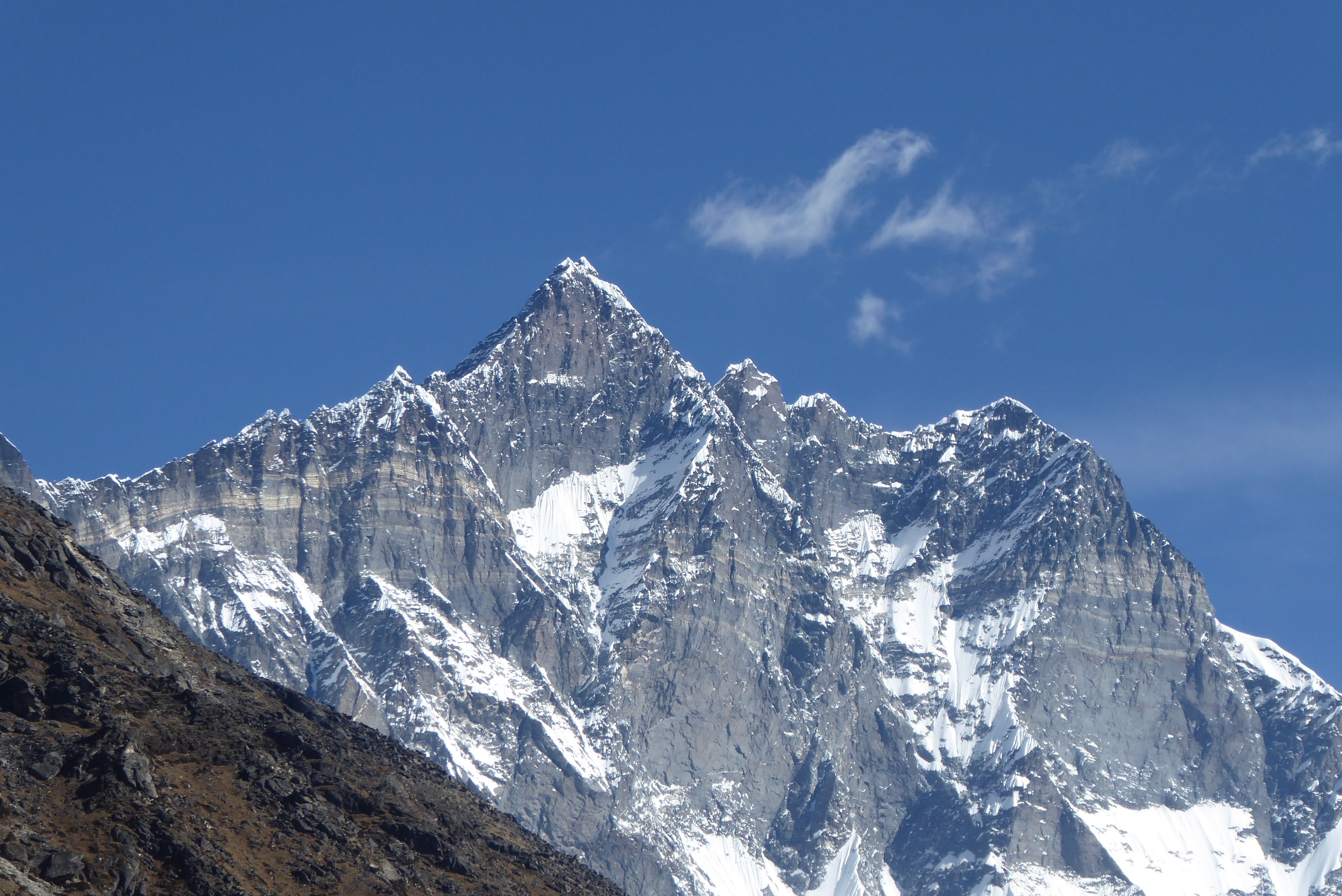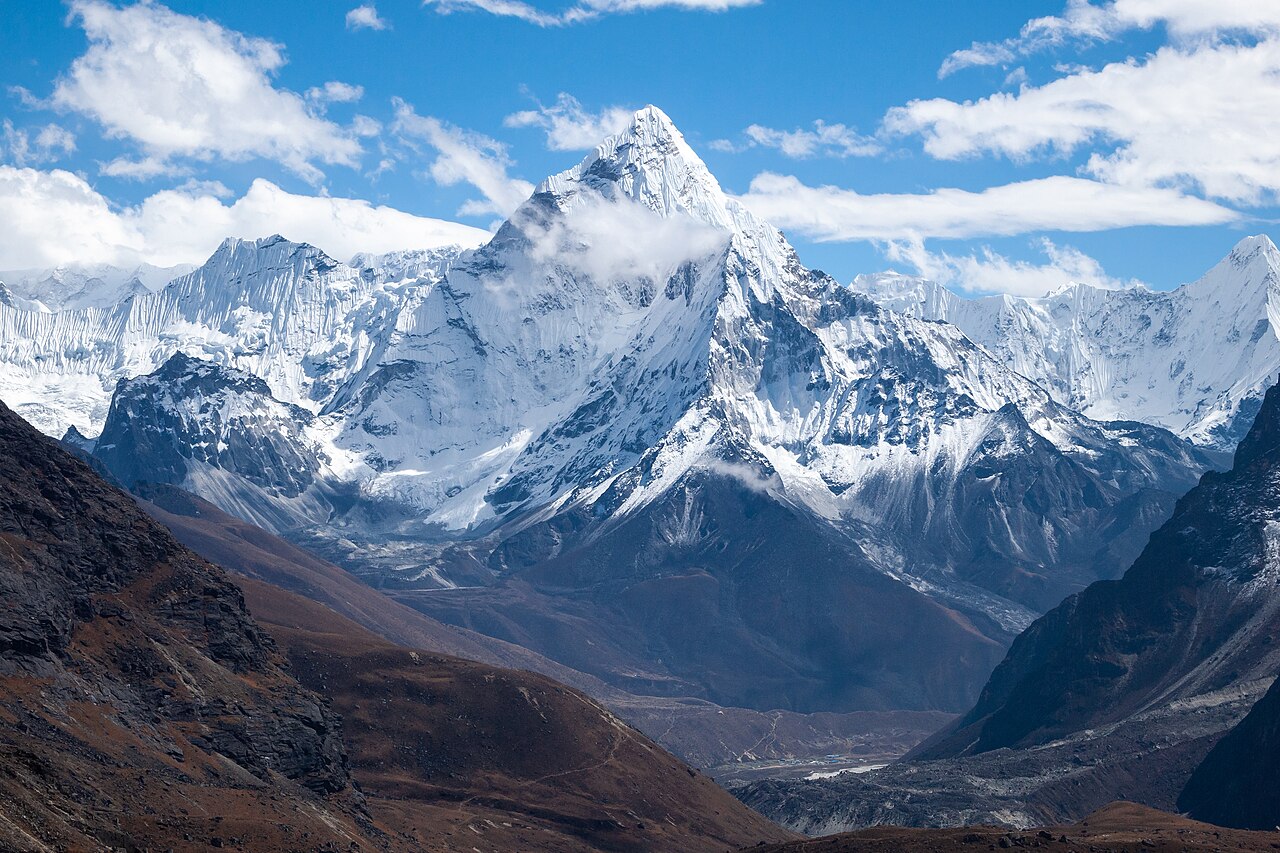
Trails and Route Overview during Ama Dablam Expedition
Ama Dablam Expedition starts in the Dudh Koshi Valley on trails passing through pine forests, terrace farmlands, winding rivers, and ethnic settlements. The trekkers then walk into the UNESCO World Heritage Site, Sagarmatha National Park, with pre-approved permits, witnessing various flora and fauna along the way. The trekkers stop at the welcoming villages of Phakding, Namche Bazaar, Dingboche, Pangboche and other Sherpa settlements. Ama Dablam Base Camp sits on a broad alpine shelf separated from the main Everest Base Camp corridor, giving the expedition a quieter atmosphere despite the mountain’s worldwide reputation.
Ama Dablam is uniquely layered in various stages. The lower approach crosses moraine, boulder fields and broken slabs. The middle ridge is sharp, rocky and intensely exposed. Higher up, the granite towers lead to mixed ground, corniced traverses and the fluted ice slopes below the summit. This compressed transition from trekking terrain to true technical alpinism is one reason Ama Dablam feels so complete and fulfilling for mountaineers. This distinct characteristic also places Ama Dablam along with other 7000ers despite its towering altitude of 6,812m.
Cultural and Traditional Experience during Ama Dablam Expedition
Sherpa settlements dominate the Khumbu valley with major trade handled by them. Apart from tea-houses and lodges, Sherpas contribute to local operations, transportation, ground handling, and other facilitation. Buddhism is widely followed by almost the entire region, therefore, monasteries, chhortens, Gompas, mani walls and prayer flags are frequently seen throughout the trail. One of the oldest high-altitude monasteries, the Tengboche monastery is a must-visit during this expedition.
Significance of the Mountain
Ama Dablam’s name is commonly translated as “Mother’s Necklace.” The long ridges are considered as a mother’s arms around her child, while the hanging glacier, the Dablam, resembles the pendant traditionally worn by Sherpa women. The mountain stands among the giant 8000ers but still dominates its presence due to its unique appearance.
Ama Dablam Summit Overview
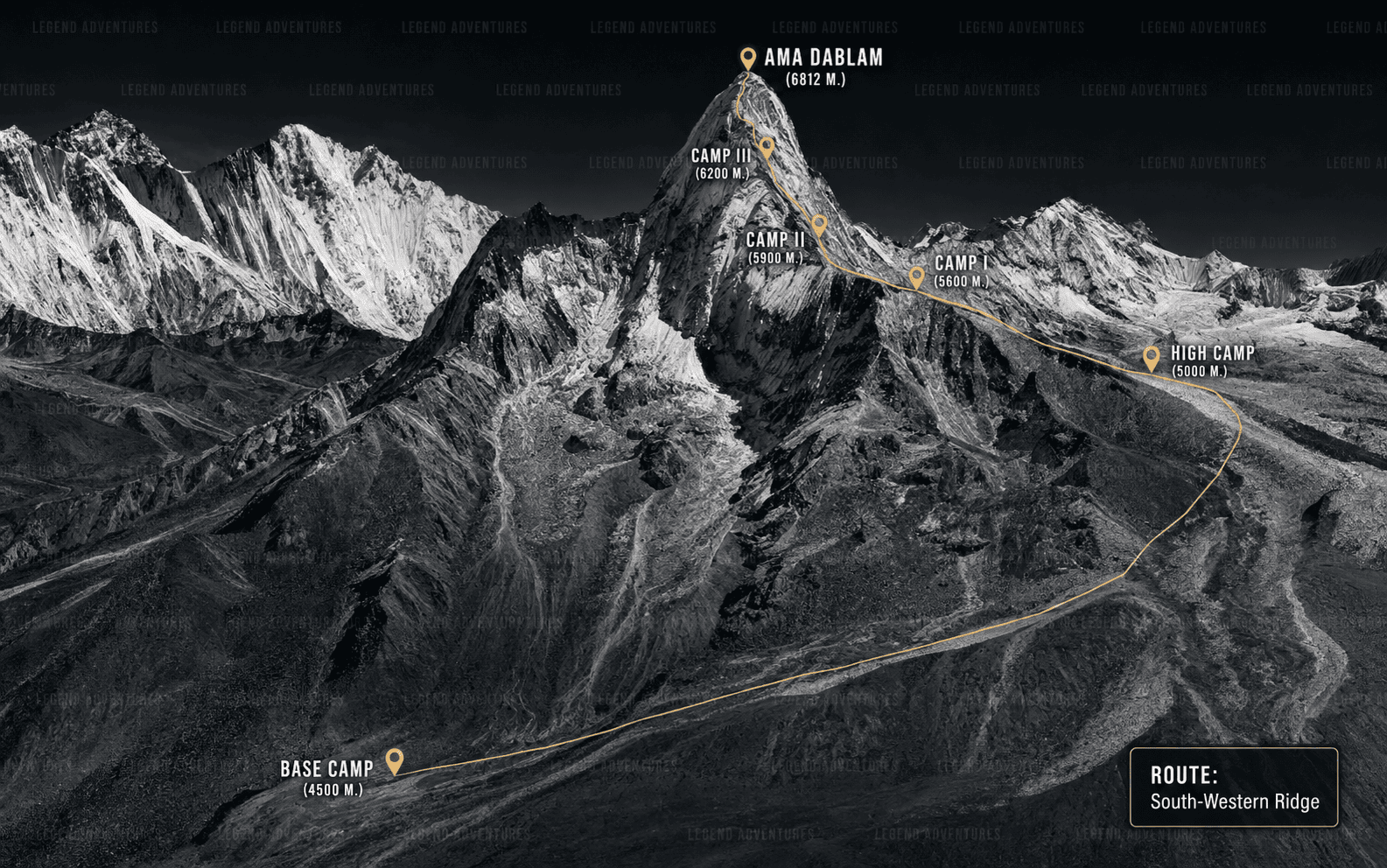
Ama Dablam has been summited successfully via the southwest ridge; therefore, it is commonly used by all climbers. The route takes the climbers over glacial moraine and rugged terrain toward Yak Camp, then continues to Camp 1 at the end of the ridge. Camp 1 exposes the direct view of the upcoming challenge near the summit.
As we cross Camp 1 and approach Camp 2, the high-altitude trek changes into technical mountaineering over a ridge leading to the Yellow Tower, the route's profound barrier. Camp 2 sits on a narrow area with smaller tents and less comfort than the base camp.
The route ahead of Camp 2 is complex with mixed terrain. The Grey Tower, steep snow and ice, and the famous Mushroom Ridge demand precise clipping, efficient front-pointing, and complete attention to rope traffic. Depending on the season, the team may establish a Camp 2.7 or Camp 3 around 6,300–6,400 meters, or launch the summit attempt directly from Camp 2.
The upper route goes around the hanging glacier and climbs the last ice grooves toward the summit. While this part may be less technically difficult than the lower ridge, the high altitude and tiredness make it challenging. The descent follows the same exposed path with repeated rope descents and careful climbing down. On Ama Dablam, reaching the summit is only halfway through the hardest day.
Best Season for the Ama Dablam Expedition
The best season for the Ama Dablam Expedition is Autumn. During October and November, the rocks are drier, visibility is clearer, and the route is more settled post-monsoon. Spring expeditions are also possible, particularly in April and May, but snow cover and changing ice conditions can change the nature of the expedition on Ama Dablam.
Even when the weather is considered favorable, the risk is never nil. Winds can suddenly build up, Mushroom Ridge can be affected by the snow, and flight timings can always shift depending on cloud conditions.
Considerations and Trip Notes for Ama Dablam Expedition
Visa Requirements in Nepal
Eligible nationalities can obtain a Nepal tourist visa in 15-, 30- or 90-day multiple-entry options. We recommend applying for a 90-day visa for the Ama Dablam expedition to cover any delays that may result due to weather conditions.
Please note that travelers who are not eligible for visa on arrival must arrange permission through a Nepali diplomatic mission before departure.
Insurance Requirements
Although Ama Dablam is a 6000er, its technicality and challenging terrain demand a standard insurance policy that covers technical mountaineering to at least 7000 metres, helicopter rescue as required, hospital treatment and deposits in Nepal, repatriation, trip cancellation and interruption.
Fitness, Technical and Experience Standards required for Ama Dablam Expedition
-
Previous technical alpine climbing is essential. Ama Dablam is not suitable as a first experience with crampons, fixed ropes or exposure.
-
A prior summit in the 5,500-6,000 metre range is strongly required, with evidence of reliable acclimatization and self-care at altitude.
-
Climbers must independently manage fixed-line ascent, rappelling, changeovers, cow’s-tail systems, rope passing and safe movement around anchors.
-
Competence on rock around French 5a / YDS 5.7–5.8, as well as steep snow, ice and mixed terrain, is expected before arrival.
-
The route requires calm movement with a 7–10 kg pack on narrow ledges and exposed ridges, including long descent days after the summit.
-
Final acceptance is based on climbing history, guide references where appropriate, medical screening and a practical skills review.
Environmental Conduct
Ama Dablam’s small camps leave no room for careless waste practices. Legend Adventures follows a strict carry-in, carry-out system. Human waste is managed through approved Base Camp toilets and sealed bags at high camps. Batteries, gas canisters, damaged ropes, food packaging and broken equipment are returned to Base Camp and documented for disposal.
The approach also passes through living Sherpa communities and protected parkland. Climbers are expected to refill drinking water rather than rely on disposable bottles, avoid unnecessary wood heating, respect monasteries and keep noise and litter away from villages and campsites.
Gear List Suggestions
-
Expedition-quality down parka and insulated trousers.
-
Double mountaineering boots compatible with technical automatic crampons and proven in cold conditions.
-
A three-layer waterproof shell system, insulated mid-layers and technical climbing gloves with warm spare mitts.
-
Low-profile harness, helmet, Jumar, descender, locking carabiners, two secure lanyards and personal anchor system.
-
Technical ice axe or lightweight alpine tool, depending on guide recommendation, plus crampons suited to rock and mixed ground.
-
Category 4 glacier glasses, storm goggles and spare eye protection.
-
A -20°C to -30°C sleeping bag for Base Camp and a compact high-camp sleeping system.
-
Headlamps with spare batteries, cold-resistant power banks, repair kit, personal medication and a tested hydration system.
A detailed equipment list is issued after booking. Every critical item should be used during training before Nepal. Ama Dablam is not the place to discover that a harness sits poorly, a descender is unfamiliar, or a boot system causes pressure points.
Team at Legend Adventures for Ama Dablam Expedition
The team for the Ama Dablam expedition with Legend Adventures comprises high-altitude mountaineering-experienced Sherpa leaders, accompanied by logistics and operations managers, guides, base camp cooks, porters, medical staff, and a liaison officer. Each climber is paired with a dedicated climbing Sherpa for the rotation and summit phases, while the expedition leader coordinates rope strategy, camp movement, weather and traffic on the confined ridge.
Base Camp support includes an experienced cook team, reliable communications, medical equipment, emergency oxygen and regular weather updates. The guide team reviews each climber’s movement during training and the first rotation. A member who cannot operate independently on the fixed ropes may be restricted from moving above Camp 1, regardless of fitness or booking status.
Important Expedition Note
Ama Dablam is shorter than Nepal’s 8,000-meter giants, but altitude alone does not describe this mountain. Above Camp 1, the Southwest Ridge becomes a sustained sequence of exposed rock, mixed climbing, steep ice and narrow snow crests. The route requires clean technique and calm judgment along with proper acclimatization during the climb.
This expedition is designed as a 30-day, fully supported climb with a gradual Khumbu approach, structured technical rotations and a flexible summit period. Camp positions, fixed lines and the use of Camp 2.7 or Camp 3 are determined by the season’s route condition.