The Physical Terrain of the Region
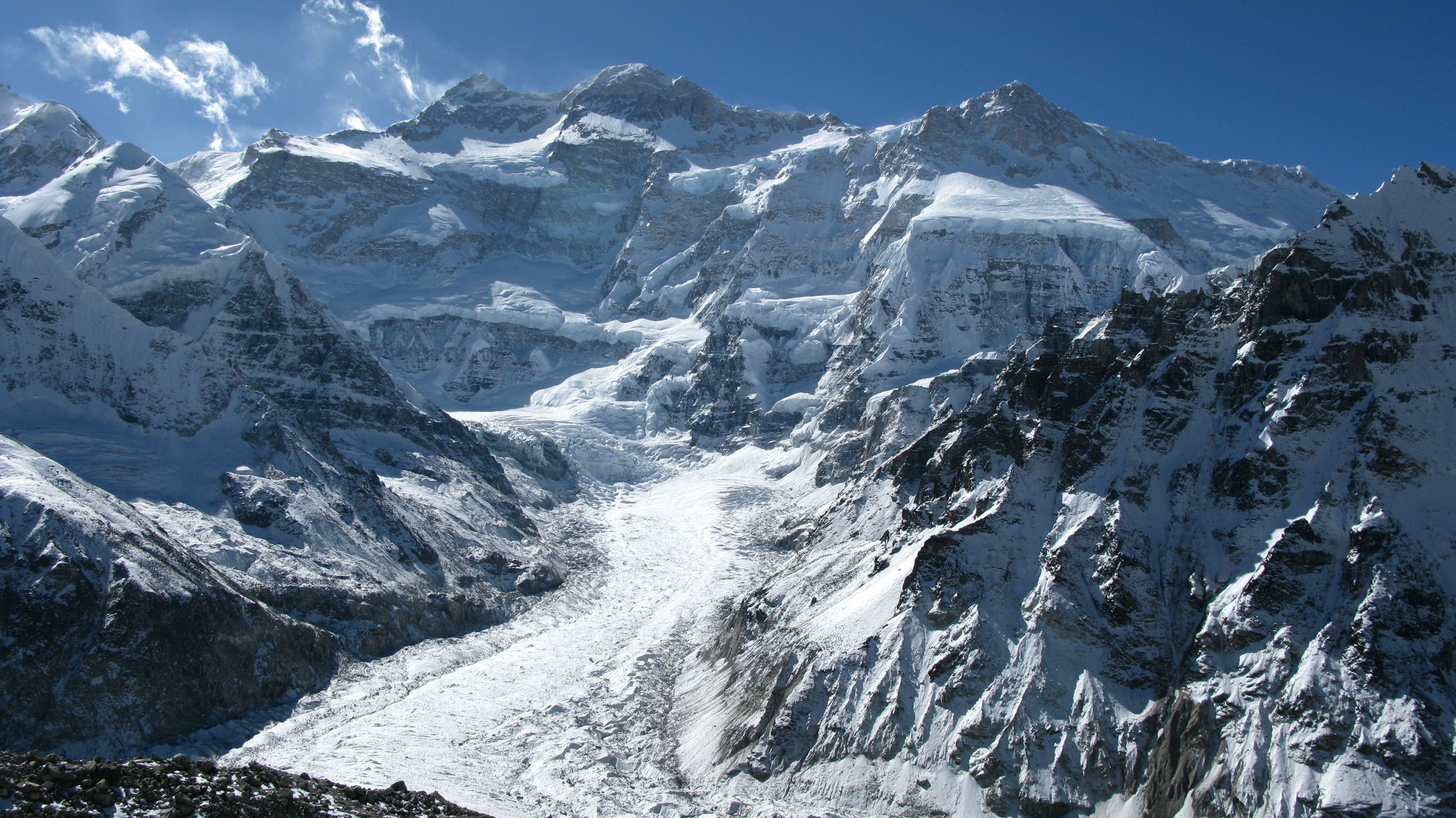
Kanchenjunga rises from one of Nepal’s most isolated mountain landscapes. The approach begins in the humid foothills of Taplejung, where terraced farms, cardamom fields and subtropical forest occupy deep river valleys. As the trail gains height, broadleaf woodland gives way to rhododendron, fir and juniper before the country opens into alpine pasture, moraine, glacier and the high amphitheater of the Yalung basin.
The Kanchenjunga Conservation Area covers approximately 2,035 square kilometers and protects an exceptional range of habitats. Red panda, musk deer, Himalayan black bear, blue sheep and snow leopard are associated with the wider region. At the same time, its forests contain an unusually rich concentration of rhododendrons, orchids and native Himalayan plants. For climbers, however, the most immediate reality is scale: long access, limited infrastructure, unsettled weather and a mountain that remains physically and logistically more committing than busier 8,000-meter peaks.
The Culture of Eastern Nepal
Ethnic communities including Limbu, Rai, Sherpa, and Tibetan inhabit the Kanchenjunga region. The villages are remote and isolated, connected by foot trails, operating local trades and tourism during peak seasons. Hospitality is often quiet and practical: a warm kitchen, local grain, tea, dried food, and the careful exchange of news between people living away from the bustling cities.
Kanchenjunga is understood locally not only as a mountain but as a sacred presence. Its name is commonly interpreted as the ‘Five Treasures of the Great Snow’, referring to the massif’s five principal summits. Respect for local beliefs is built into the expedition. The climbing program begins only after the Puja ceremony, when a lama blesses the team, equipment and route and asks for safe passage.
The Summit Overview: Kanchenjunga via the Southwest Face
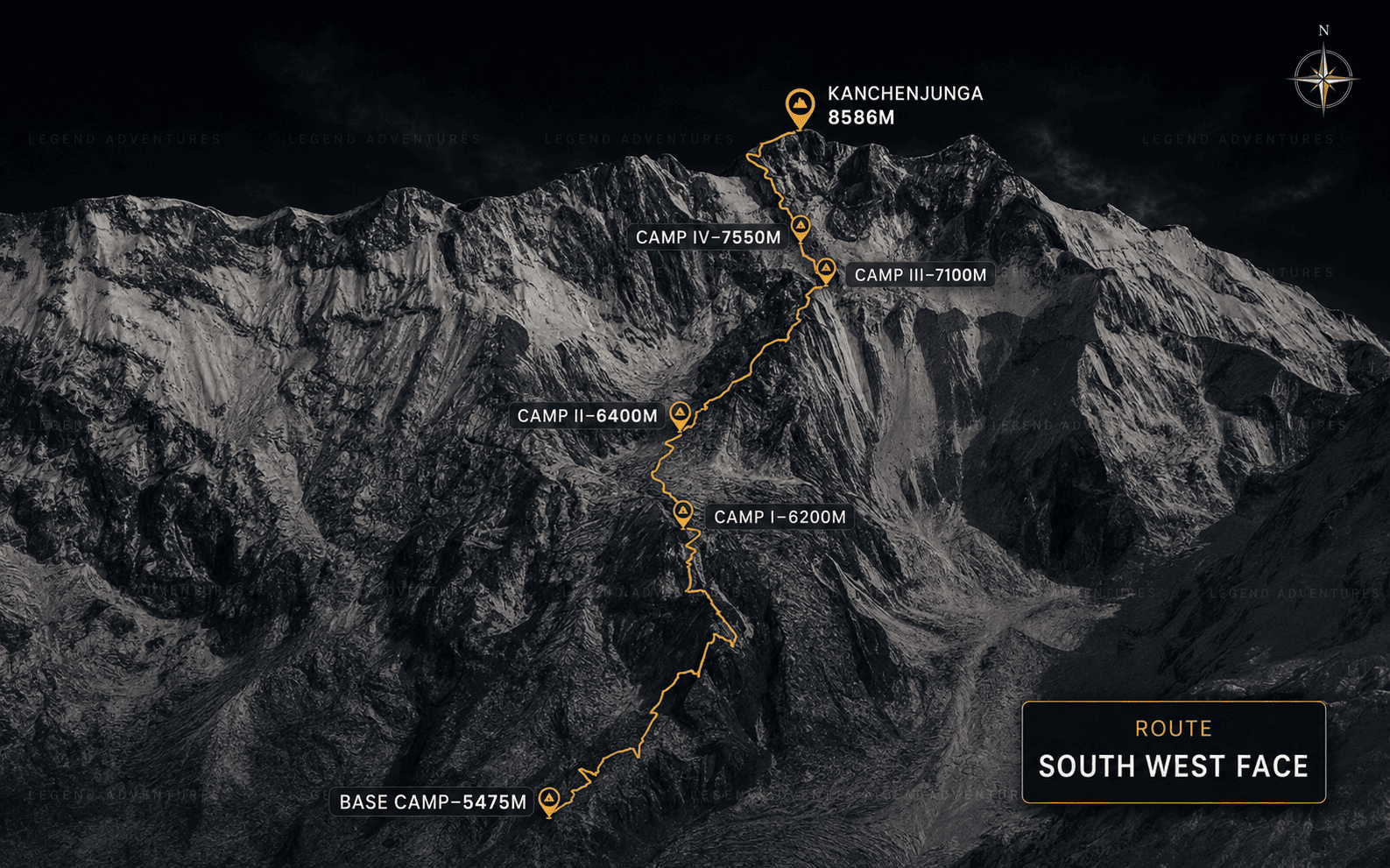
The standard Nepal-side expedition approaches from the south through the Yalung Glacier. From Base Camp, the route develops across broken glacial terrain and crevassed snowfields before rising through a sequence of high camps. The exact line changes from year to year as snow bridges, seracs, crevasses and fixed-rope anchors respond to winter accumulation and glacier movement.
Camp 1 is normally placed above the lower glacier, establishing the first secure platform on the mountain. Camp 2 extends the route onto steeper, more sustained terrain, while Camp 3 brings climbers into the severe physiological environment above 7,000 meters. Camp 4 is the launch point for the summit push. From there, the climb continues through steep snow and mixed ground toward the upper ridge and summit area.
Kanchenjunga is not climbed by treating summit day as the only difficult section. The expedition is a prolonged test of endurance, technical efficiency and decision-making. Long rotations, repeated high-camp carries, limited recovery and the remoteness of the mountain create cumulative strain. Climbers must remain capable of descending independently even after the psychological goal of the summit has been reached.
Best Season for the Kanchenjunga Expedition
Spring is the established season for a Nepal-side Kanchenjunga expedition. Teams normally enter the region in April and position the summit attempt for May, after route work and acclimatization are complete but before the full monsoon reaches eastern Nepal. The mountain’s location makes it especially exposed to moisture and unstable weather arriving from the Bay of Bengal.
A weather window should never be understood as comfortable or risk-free weather. It is a period in which wind, precipitation, cloud development and temperature are judged acceptable relative to the surrounding forecast. The final decision to move rests with the expedition leader and may change after the team has already left Base Camp.
Considerations and Trip Notes for Kanchenjunga Expedition
Visa Requirements
Nepal provides tourist visas on arrival to eligible nationalities in 15-, 30- and 90-day options. Current official fees are US$30, US$50 and US$125 respectively. Because the expedition lasts around 50 days and domestic weather delays are possible, the 90-day option is normally the most practical. Travelers who are not eligible for a visa on arrival must arrange entry permission through a Nepali diplomatic mission before departure.
Insurance Requirements
Standard trekking or general travel insurance is not adequate. Every climber must hold a specialist policy that explicitly covers technical mountaineering above 8,000 meters, helicopter evacuation where operationally possible, hospital treatment and deposit guarantees in Nepal, repatriation, trip cancellation and interruption.
It is necessary to understand that insurance covers rescue and evacuation costs, but it does not guarantee the help can reach the climbers at any cost when conditions are unfavorable. Above the reliable aviation zone, evacuation begins with guides and Sherpas moving the casualty down through fixed lines and high camps until aircraft access or ground transport becomes possible.
Fitness, Technical and Experience Standards
-
A successful summit above 7,000 meters is the minimum entry standard. Previous experience on an 8,000-meter peak is strongly preferred.
-
Climbers must be efficient with automatic crampons, front-pointing, fixed-line ascent, Jumar transitions, rappelling, anchor changeovers and crevasse-rescue procedures.
-
Independent operation of oxygen masks, regulators and cylinder systems is mandatory before the summit push.
-
Participants must remain functional while carrying approximately 10–12 kg at extreme altitude and must be able to manage clothing, hydration, food and personal equipment inside a high camp.
-
Acceptance is subject to a climbing-resume review, medical screening, guide references where appropriate and a practical technical assessment.
Environmental Conduct
Legend Adventures operates with a strict carry-in, carry-out policy. Human waste must be managed through approved toilet systems and sealed waste bags where required. Oxygen cylinders, batteries, packaging, damaged tents and all non-biodegradable material are returned from the mountain. Nothing may be discarded into crevasses or left at high camps for convenience.
Gear List Suggestions for Kanchenjunga Expedition
-
A down suit specific for 8000m expedition with a proven layering system and three-layered waterproof shell,
-
Triple mountaineering boots suitable for approximately -40°C, with tested liners and expedition socks.
-
Category 4 glacier glasses, storm goggles and a spare eye-protection system.
-
Automatic crampons, low-profile harness, helmet, alpine axe, Jumar, descender and fixed-line safety system.
-
A -40°C sleeping bag, insulated high-altitude sleeping system and dual-pad arrangement.
-
High-altitude mitts, spare gloves, face protection, vapor barriers and expedition-grade headlamps.
-
Cold-resistant power banks, satellite communicator where required, personal medication and a carefully tested hydration system.
A final itemized checklist is issued after booking. New equipment should never be taken directly to Kanchenjunga without being tested during training or a prior expedition.
Team Expertise at Legend Adventures
The expedition is led by an experienced high-altitude leadership team supported by a senior Sirdar, Base Camp manager, cooks, logistics staff and one dedicated high-altitude Sherpa for each climber. The Sherpa partnership covers rotations, high-camp load support, oxygen staging, summit-day movement and descent assistance.
Base Camp maintains satellite communication, weather forecasting, emergency oxygen, medical equipment and a documented evacuation plan. Daily health observations are used to identify deterioration early. Decisions are made from the combined picture of weather, route condition, oxygen reserves, pace, health and the ability to descend.
Important Expedition Note
Kanchenjunga is a serious, remote 8,000-meter objective. The expedition is designed around a standard commercial expedition on the Nepal-side Southwest Face, with an approach through eastern Nepal, staged acclimatization, high-camp rotations, supplemental oxygen and one-to-one high-altitude Sherpa support. Camp positions, helicopter sectors, oxygen allocations, and summit-day plans may change according to route conditions, weather, government directives, and the expedition leader’s judgment.
No itinerary can guarantee a summit. Legend Adventures treats a safe return as the primary measure of a successful expedition.