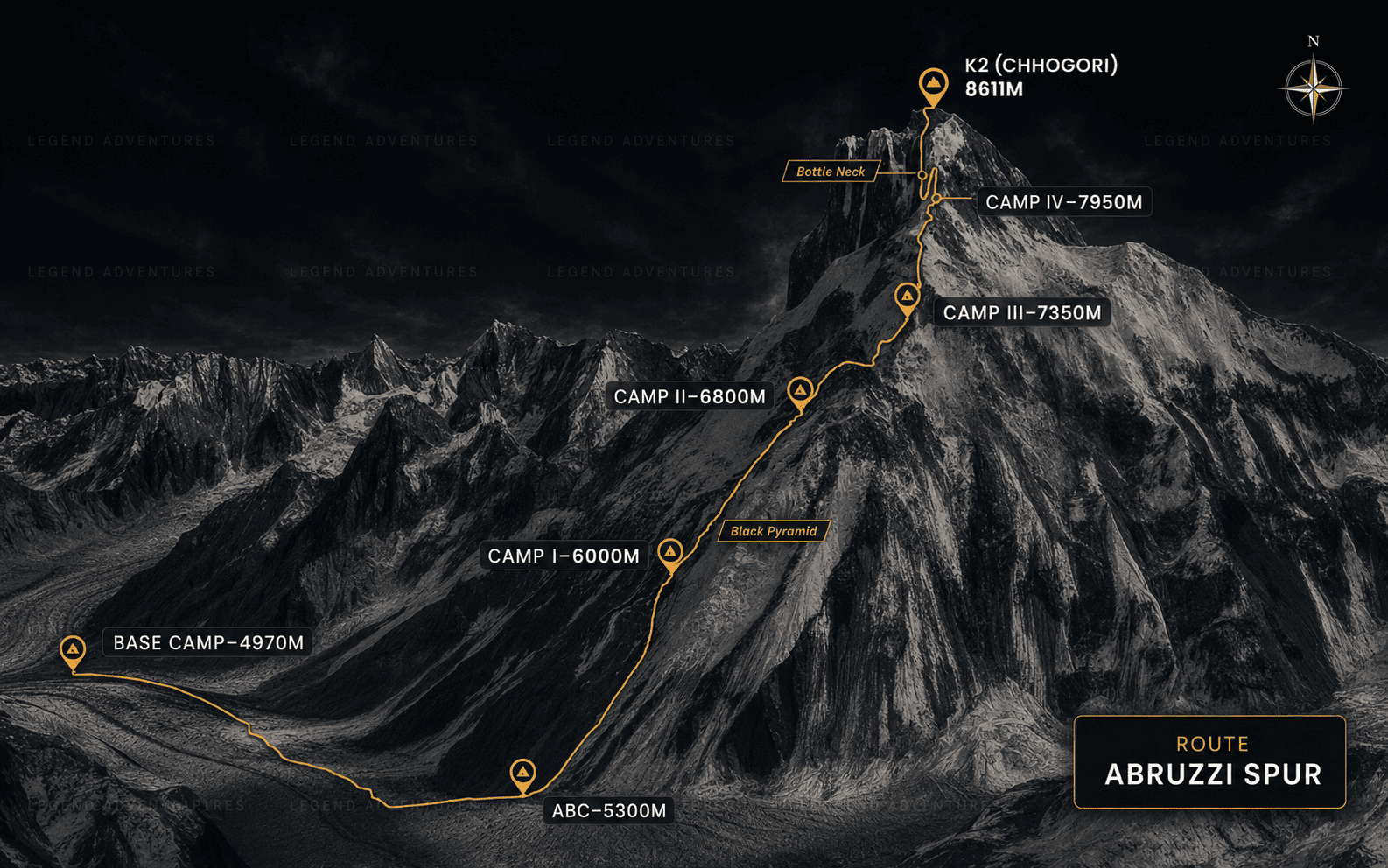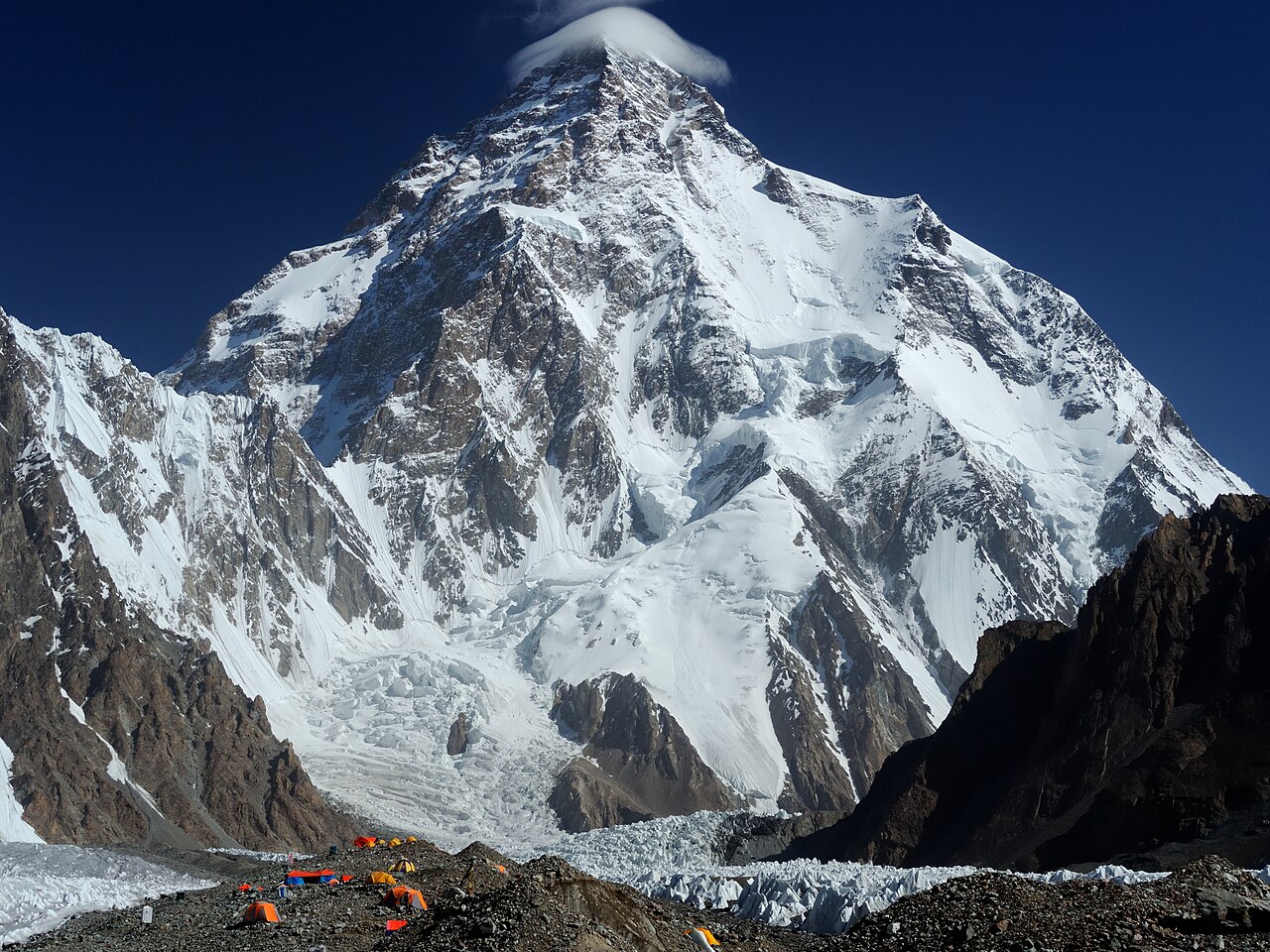
The K2 expedition is a mountaineering journey to climb K2, the second-highest mountain in the world at 8,611 meters. It is located in the Baltoro region of Pakistan. And, only a few hundred people have successfully climbed to the top of K2 Expedition successfully, and the popular Abruzzi Spur to the summit of the 8000m peak remains one of the deadliest routes to the summit.
K2 is quite different from Mount Everest in the number of determined routes available on it; in the case of K2, there are many difficult sections. The most popular route to the summit of K2 begins with a flight to Islamabad and another short domestic flight to Skardu. From there, it's a week-long hike through Askole and over the Baltoro glacier to Concordia, a vast amphitheatre at the summit of the Baltoro glacier, offering a view over the whole Karakoram range.
From there, you will have to make your way up to the first camp (5,150 m) following the route through House’s Chimney and Black Pyramid to get to Camp 3. Climbers will have to make several more trips from Camp 3 to reach other camps in the area, referred to as the Shoulder, before ascending the daunting Bottleneck to the top. This is not only a tough route, but one of the most out-of-the-way Karakoram routes as well, making it even more interesting and rewarding to reach the summit.
The best season to climb Mt. K2 Expedition
The best season for climbing Mount K2 Expedition in 2027 is the summer season. The hot summer air of the famous monsoon exercises lesser effect on the Karakoram region. This hot and moist wind loses its strength while climbing above the mountain ranges and plateaus near sea level. Due to this, the weather becomes relatively stable for the people trying to achieve this adventurous task. The mountaineers usually prefer July and August, which are the months of the summer season for climbing Mount K2.
Training and Preparation
It is not a recommended first 8,000m peak on which to climb K2. It is better to have to have 8,000m peaks behind you, such as Manaslu or Cho Oyu. Also, you must be experienced in technical climbing, such as traversing fixed ropes, jumars, and glaciers. The technical training should begin 6-8 months prior to the expedition, and cardio should begin 6-8 months prior to the expedition. It is important to undertake long walks/ runs while wearing a backpack, do abdominal exercises, and have experience using climbing equipment such as crampons, ice axes, and ropes. Another crucial component of the K2 Expedition prep is learning to walk daily with a heavy pack (15-20kg) for a week or more.
Previous experience of climbing 6000-7000m peaks will also be helpful as the body will be familiar with the high altitude and will not need to acclimatise itself when climbing K2.
Gear and Equipment
K2 requires the full high-altitude mountaineering kit, given the sustained technical climbing and extreme conditions above Camp 3.
-
8,000m-rated down suit and high-altitude summit boots
-
Sleeping bag rated to -40°C
-
Crampons, harness, ascender, ice axe, and carabiners
-
Helmet, headlamp, glacier glasses, and sunscreen
-
Base layers, mid layers, and insulated jacket for lower camps
-
Personal first-aid kit and any prescribed medication
-
Trekking poles, duffel bags, and a daypack
-
Supplemental oxygen, mask, and regulator (provided by the team)
-
Fixed ropes and route preparation, Base Camp to summit (provided by the team)
-
Camping and Base Camp equipment (tents, kitchen, dining facilities)
-
High-altitude rescue insurance covering evacuation to at least 8,611m
Safety and Support
Experience, ratios and margins are the key to safety on K2. A well-managed expedition maintains a low climber-to-Sherpa ratio, typically about 01 guide for each climber - on the summit day at least and has a Base Camp manager, weather forecaster, and liaison officers. Supplemental oxygen is routinely used above Camp 3 and rescue options include helicopter evacuation from Base Camp (weather permitting) and a deliberate multi-rotation acclimatization scheme through the lower camps.
A founder himself, Pemba Rita Sherpa is also a 14-time Everest summiteer and is a skilled weather window reader and team pacing guide, with hands-on experience on how to traverse long and arduous days at high elevations.